Dinlemek / İzlemek İçin Dokunun
Bartok Concerto for Orchestra, Sz. 116
Béla Bartók
Klasik Müzik - Modern Ve 20Th Century
3 Mart 2018
Sanatçıya Dön
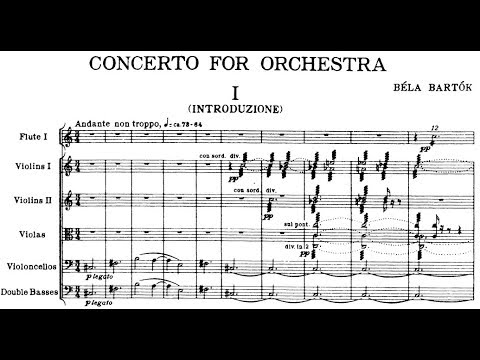
Bartók's Concerto for Orchestra is one of his best-known, most popular and most accessible works. Like his fourth and fifth string quartets (1928 and 1934), the piece is in five movements, arranged in what is called an "arch" form, in which the first and fifth movements are related, as are the second and fourth, with the third movement functioning as the keystone of the arch. The Concerto's opening bars present a theme of rising fourths in cellos and basses, answered by tremolando strings and fluttering flutes in Bartók's characteristic "night music" style. Trumpets, pianissimo, chant a pungent, short-phrased chorale on which the theme of the main Allegro vivace is based. A lyrical second theme (4:08) is introduced by the oboe, but the mood remains dark as the material is developed. Only when brass erupt in a modal fugato section (6:37) is there the suggestion that things may lighten. Bartók noted that the progress of the concerto was toward light from initial darkness, and that the thematic material of the fugato will return in modified form as the basis of the joyous moto perpetuo finale.
The second movement is titled "Games of Couples," and presents woodwinds in successive pairs, with close intervallic relationships derived from Dalmatian folk music. The syncopated rhythm that accompanies these games -- performed by side drum without snares -- carries over into the middle section, a soft chorale for brass (12:25). Bartók described the keystone third movement, "Elegia," as a "lugubrious death-song," in which unsettled "night music" effects alternate with intense, prayerful supplications (again related to the chorale-like material that pervades the first half of the work). The subsequent "Interrupted Intermezzo" presents the first real carefree moments of the work, with its satiric treatment of the march theme from Shostakovich's "Leningrad" Symphony (25:30), which Bartók heard in a radio broadcast. Bartók scholar Elliott Antokoletz notes that the movement's warm, cantabile melody for violas (24:31) quotes a popular song by Zsigmond Vincze, "You are Lovely, You are Beautiful, Hungary," bringing an unmistakable note of homesickness to the music. The finale opens with a leaping call to order for all four horns unison, followed by a wild moto perpetuo dance, in which the succeeding episodes hardly stop for breath. Bartók provided two endings, the first rather abrupt, the second more traditionally climactic, and making use of the upward-moving minor third motif that served as an intervallic motto for Bartók in many works. The alternate ending is the one that is usually played.
0:00 - Introduzione. Andante non troppo
9:29 - Giuoco delle coppie. Allegretto scherzando
15:55 - Elegia. Andante non troppo
23:38 - Intermezzo interrotto. Allegretto
27:40 - Finale. Pesante - Presto
Performed by the Chicago Symphony Orchestra
Pierre Boulez, conductor
Yorum yapmak için giriş yapın.
Henüz yorum yapılmamış. İlk yorumu sen yaz!
Çalma Listesi (Sıradaki Parçalar)

Bartók Gliss vs. 3 Hands
8 Şubat 2023
Bartok Concerto for Orchestra, Sz. 116
3 Mart 2018

Bartók: Konzert für Orchester ∙ hr-Sinfonieorchester ∙ Andrés Orozco-Estrada
23 Haziran 2017

Béla Bartók - Romanian Folk Dances for String Orchestra Sz.56 BB 68
15 Ocak 2017

Bela Bartok - 6 Romanian Dances for Violin and Piano
24 Ocak 2016

Béla Bartók: Romanian Folk Dances | Tessa Lark, Yannick Rafalimanana
7 Ocak 2014

Allegro Barbaro (Sz.49) - Béla Bartók
27 Temmuz 2010

Bartók: The Miraculous Mandarin / Mehta - Berliner Philharmoniker
5 Mayıs 2010

Bartok - Three Etudes op. 18 (Zoltan Kocsis)
27 Mart 2009

Béla Bartók - Music for Strings
4 Mart 2008
Müzik Kategorisi Canlı Sohbet Kök Kategori Ortak Oda
Tüm müzik kategorileri için merkezi canlı sohbet ve ses odası 24 Saatlik Geçmiş
Bağlanıyor...
0 Çevrimiçi
Sesli Sohbet
Kimse yok.
Çevrimiçi ()
Mesajlar yükleniyor...